

Opinion Magazine
Number of visits: 10,201,805
  •  Home
  • Opinion
    • Opinion
    • Literature
    • Short Stories
    • Photo Stories
    • Cartoon
    • Interview
    • User Feedback
  • English Bazaar Patrika
    • Features
    • OPED
    • Sketches
  • Diaspora
    • Culture
    • Language
    • Literature
    • History
    • Features
    • Reviews
  • Gandhiana
  • Poetry
  • Profile
  • Samantar
    • Samantar Gujarat
    • History
  • Ami Ek Jajabar
    • Mukaam London
  • Sankaliyu
    • Digital Opinion
    • Digital Nireekshak
    • Digital Milap
    • Digital Vishwamanav
    • એક દીવાદાંડી
    • काव्यानंद
  • About us
    • Launch
    • Opinion Online Team
    • Contact Us

Contemporary Dalit Politics and Ambedkar’s Goal of Caste Annihilation

Ram Puniyani|English Bazaar Patrika - OPED|3 March 2014

On 28th Feb (2014) Ramvilas Paswan of Loktantantrik Jan Party joined the NDA alliance. Same Paswan had left the NDA twelve years ago with the beginning of Gujarat carnage, saying that with the violence in Gujarat he cannot be part of NDA. This time his son formulated the face saver when he said that Modi has received clean chit in the Gujarat carnage. Few days ago another dalit leader Udit Raj directly joined BJP, with the assurance of being given a ticket for forthcoming elections. In Maharashtra, Ramdas Athwaley of Republican Party of India had become part of NDA, and succeeded in being nominated for Rajya Sabha, Upper house of Parliament. There are many others dalits in the fold of BJP directly or in alliance with BJP to be in NDA, for pre poll alliance.  Most of these leaders claim to be working on the path shown by Dr. B.R. Ambedkar. Ambedkar was committed to annihilation of caste and was totally opposed to the concept of Hindu nationalism, as propounded by RSS-BJP.

During freedom struggle when three types of nationalisms were in vogue, Indian Nationalism, Muslim Nationalism and Hindu nationalism, majority of the people of India supported and followed the path of Indian nationalism. Majority Hindus were for Indian nationalism, majority of Muslims were also for Indian nationalism. It was the elite, the landlord, Kings who began communal streams and were later joined in by a section of affluent upper castes of those religions. The British manipulation kept fuelling the fire of religious nationalism. Muslim nationalism turned in separatist direction and their demand for Pakistan came to the forefront. Hindu nationalists accepted the religion based nationalism but denied the demand of Pakistan on the ground that this had been a Hindu nation from times immemorial. This whole formulation of Hindu nation from ancient times is an invalid concept, as the very concept of nation, Nation state is a modern concepts. So in the revised edition of his book, ‘Partition of India’, Dr. Ambedkar opposed the formation of Pakistan on the following ground that formation of Pakistan may pave the way for Hindu Raj and “If Hindu Raj becomes a reality then it would be greatest menace to this country. Whatever may Hindus say, actually it does not make a difference that Hinduism is a danger to Independence, Equality and Brotherhood. Thus it is an enemy of democracy. We should make all out efforts to stop Hindu Raj from becoming a reality.” (Pakistan or Partition of India, Page 358). Here what Ambedkar is referring to Hinduism is Brahmanical Hinduism, the ideological ground of Hindutva, the agenda of RSS combine.

Ambedkar did lay the foundations of dalit movement, and went on to form Scheduled Caste Federation (SCF) in due course; before conceptualizing the Republican Party of India. This SCF in 1951, on the eve of First General elections in 1952; which was to begin the process of adult suffrage, forged an alliance with Praja Socialist Party (PSP) led by Jaya Prakash Narayan. The manifesto of SCF ruled out “alliance with any reactionary party such as Hindu Mahasabha and Jan Sangh (Previous avatar of BJP) (quoted from Gopal Guru EPW Feb 16, 1991, citing Ambedkar Letters to Gaikwad, page 280-296). He was the one who could see the long term agenda of Jan Sangh-Hindu Mahasabha of Hindu Rashtra, the concept totally opposed to secular democratic India. His basic motto was ‘educate, organize and struggle’, for caste annihilation and for the values of substantive Liberty, Equality and Fraternity. He was aware that this process; educate and organize to struggle; is possible only in a democratic set up, so alliance with Hindutva political outfits was ruled out of hand.

Today what is happening? From last several years a new dalit leadership has emerged, which on one hand represents a faction of this group and on the other has also personal-family electoral ambitions. So in short term they, for their personal benefits have been sitting in the laps of communal parties. Namdeo Dhasal, the great poet went with Shiv Sena, which had created hell with the publication of Amdekar’s ‘Riddles of Hinduism’. Ramdas Athwaley is again with the communal forces who have given him the Rajya Sabha seat. Udit Raj has also embraced the party of Hindu raj and Ramvilas Paswan, guided more by personal political ambitions, rather than the long term benefit of the downtrodden, has shamelessly allied with BJP. In the short term these dalit politicians may benefit but at the same time they will strengthen the politics of Hindutva-Hindu raj, the system of inherent hierarchy of caste and gender.

A single example will tell us about the approach of BJP towards the dalit question. Recently a book penned by BJP Prime Ministerial candidate Narendra Modi has been withdrawn, Karma Yoga. Modi in his book wrote “I do not believe that they (Valmiki’s) have been doing this job just to sustain their livelihood. Had this been so, they would not have continued with this type of job generation after generation…At some point of time, somebody must have got the enlightenment that it is their (Valmikis’) duty to work for the happiness of the entire society and the Gods; that they have to do this job bestowed upon them by Gods; and that this job of cleaning up should continue as an internal spiritual activity for centuries. This should have continued generation after generation. It is impossible to believe that their ancestors did not have the choice of adopting any other work or business.” (http://epaper.timesofindia.com/Repository/ml.asp?Ref=VE9JQS8yMDA3LzExLzI0I0FyMDA3MDA%3D&)

On the same issue of scavenging, Dr. Ambedkar makes scathing critique of the social order where a section of people have to do such demeaning and humiliating jobs. While claims are made about the development and ‘concern for all communities’ the conditions of dalits in Gujarat are abysmal, temple entry is opposed at places, there is low rate of conviction for anti dalit atrocities, there is prevalence of manual scavenging still prevalent and this receives glorification from Modi. There is denial of access for water to the main sump at places. Cases of intimidation of dalits wanting to convert to Buddhism have been reported from Gujarat. These are few of the phenomenon prevalent in the Laboratory of Hindu rashtra, Gujarat. What should one say of leadership of dalits who compromise the values of Dr. Ambedkar, the values of long term goals of social justice and annihilation of caste for their short term greed for electoral power for their own self? There is a need for introspection by these leaders and their followers about the opportunism and lack of principles of such people in the positions of leadership of the communities.

Loading

Liberal Hinduism versus Sectarian Hindutva

Ram Puniyani|English Bazaar Patrika - OPED|26 February 2014

Banning or attacking the books in current times has been aplenty. There have been many reasons given for this intolerant attitude by different social-political groups. The cases of Satanic Verses by Salman Rushdie, Taslima Nasreen’s Lajja, book on Sonia Gandhi Red Saree, A.K. Ramanujan’s Three Hundred Ramayans are some of the major examples. There is a tight rope walk between freedom of expression and hurting ‘others’ sensibilities, which keeps fluctuating for same political groups. Those from Hindu right will talk of freedom of expression for Salman Rushdie or Taslima Nasreen, while the Muslim fundamentalists will talk of ‘Hurting religious sensibilities at the same time. In case of ‘The Hindus an Alternative History’ by Wendy Donigar or ‘Three Hundred Ramayanas’ the same Hindu right will assert the religious sensibility argument to get the uncomfortable things banished away. The overall victim of this intolerant attitude is freedom of expression and it also shows the ascendance of ‘Taliban’ elements in the social political sphere.
The ‘out of court settlement’ reached by Penguin to pulp its stock of ‘The Hindus-an alternative History’ is a very condemnable move from one of the most powerful publishers, who could have taken the matters further to the highest legal battles and preserved the right of a scholar to disseminate her views, and the right of readers to have access to it. It is in the fitness of things that well known Penguin authors Jyotirmaya Sharma and Siddharth Varadrajan have written to Penguin to pulp their books and cancel their agreements. The case against The Hindus… was filed by one Dinanath Batra of Shiksha Bachao Andolan Samiti (SBAS). In his petition to the court, the book is described as “shallow, distorted…a haphazard presentation riddled with heresies and factual inaccuracies”, and …that Doniger herself is driven by a “Christian Missionary Zeal and hidden agenda to denigrate Hindus and show their religion in poor light”. Interestingly Doniger is no Christian, she is Jewish. In her preface she writes “Part of my agenda in writing an alternative history is to show how much the groups that conventional wisdom says were oppressed and silenced and played no part in the development of the tradition—women, Pariahs (oppressed castes, sometimes called Untouchables)—did actually contribute to Hinduism…to tell a story of Hinduism that’s been suppressed and was increasingly hard to find in the media and textbooks…It’s not about philosophy, it’s not about meditation, it’s about stories, about animals and untouchables and women. It’s the way that Hinduism has dealt with pluralism.”

The two central aspects of the book are, one a presentation of the matters related to sex, which has become a taboo for the self proclaimed custodians of Hinduism. One knows the great creations like Khajuraho and Konark and the depiction of matters related to sex, that’s how it was looked at as and that’s how it prevails in society, before the Victorian prudishness took over. One recalls the classic of Kalidas; ‘Kumar Sambhav’, canto 8, which gives the erotic episode of Shankar and Parvati. And same way Adi Shankaracharya’s, Saundarya Lahiri, which gives graphic descriptions of the goddess, sholaka 78-79 being two examples.

As far as attack on Doniger’s book is concerned it is part of the long sequence of the agenda of SBAS and the other RSS affiliates like VHP, Bajrang Dal etc, who became more assertive after the decade of 1980s. This is also the period when the touchiness about religious sensibilities and suppression of the freedom of expression became a phenomenon of regular occurrence. It is interesting to note that the paintings of M.F. Husain drawn in the decades of 1960s and 1970s came under attack much later, during the 1980s with the rise of the aggressive presence of politics, which began around the Ram Temple issue.

Batra, who filed the suit, is the head of the Vidya Bharati’s Akhil Bharatiya Shiksha Sansthan, the educational arm of the Rashtriya Swayamsevak Sangh, the patriarch of the Hindu right. The earlier major book under its attack was A.K. Ramanujan’s classic essay ‘Three Hundred Ramayanas’, which was part of the syllabus in Delhi University. This essay shows the wide prevalence of diverse telling of story of Lord Ram. These diverse versions are not in conformity with the version of Ram story which gels with the Ram Temple campaign. Even before the attack on this book, the RSS supporters had attacked an exhibition of many tellings of Ram story by Sahmat. In a similar vein RSS’s political wing BJP’s political and ideological partner Shiv Sena in Maharashtra had opposed the publication of the book ‘Riddles of Ram and Krishna’ as in this book Ambedkar, apart from other things, says that he will not regard Ram Krishna as Gods and nor will worship them.

Doniger has been a Professor at School of Oriental and African Studies in University of London. She has two doctorates in Sanskrit and Indian studies and has written several works of scholarship on Hinduism. She says that Sanskrit and vernacular sources are rich in knowledge of compassion for deprived sections of society, women and pariahs as well. An example of this is in order, she is critical of Manu smiriti as it denigrates the women, at the same time she appreciates the sensitivity with which Vatsayanan’s Kam Sutra deals with women.

The tirade of SBAS and other RSS progeny against differing versions of Hinduism, and iconography is a part of its political agenda. It harps on the Brahamanical version of Hinduism bypassing and undermining the other Hindu traditions, Nath, Tantra, Bhakti, Shaiva, Siddha etc. The construction of RSS brand of Hinduism is a part of its Hindutva project, which took place during colonial period. Hindutva is the political ideology of this supra political organization, RSS. Hindutva picks up its version of Hinduism from the elaboration of European Orientalist interpretation of Hindu traditions. Orientalist scholars were in tune with the monotheistic worldview and that was reflected in their reading of Hinduism. In their rendering Hinduism got straight jacketed into monotheistic, monistic one and this puritan monolithic notion of Hinduism came to be presented as the Hinduism. The Colonial powers’ monotheistic worldview could not fathom the diverse richness of Hinduism’s philosophical, spiritual, religious and aesthetic expressions. Their understanding of religion revolves around a single Prophet. Hinduism as a religion as such is a conglomeration of multiple traditions which were prevalent here. Brahmanism was just one of them. During the colonial period by selectively projecting Brahmanical texts and values as Hinduism, the Orientalist scholars and British rulers gave legitimacy to caste and gender based Brahiminical tendency as ‘The Hinduism’. Brahmanism started becoming projected as the Hinduism. It is due to this that Ambedkar went on to say that ‘Hinduism is Brahmanic theology’. He was criticizing the social inequality prevalent in the name of Hinduism. Opposed to Brahmanical stream was the Shramnanic traditions of Hinduism, which by that time were out of the horizon of scholarship of Westerners and the British policy makers. In due course the declining sections of Hindu Landlords and upper caste resorted to the politics of Hindutva, which in the name of glorious Hindu traditions wanted to uphold the status quo of caste and gender, wanted to retain its hegemony in social and economic sphere. The freedom movement and its leader Gandhi’s Hinduism was away from this Brahmanical-Hindutva stream. It was more in continuation with liberal Hindu belonging to Shramanic tradition. It is the Hinduism with which the large sections of Hindus could identify.

Hindu Mahasabha and RSS brand of Hindutva was a marginal phenomenon as it was elite Brahamnical and harped on the values which were at deeper level undermining the status and dignity of women and dalits. That’s how RSS and the elite supporting them kept aloof from the social changes of caste and gender during this period, and stuck to their agenda of Hindu nation based on their own sectarian interpretation of Hinduism. The RSS, in pursuance of its agenda floated SBAS, which was the one which was instrumental in communalization of the history text books during the NDA regime, led by BJP-Atal Bihari Vajpayee. The same organization is the one which is at the back of the multitude of educational endeavors and promotes the divisive-sectarian history through many Sarswati Shishu Mandirs, Ekal Vidyalayas amongst others. So, for them Doniger’s book is a red rag as it talks of rich diverse traditions of the people and is not prude enough to suppress the narrations related to sex. Doniger talks of liberal Hinduism while RSS wants sectarian Hindutva imposed on the society. The struggle between liberal Hinduism and sectarian Hindutva is in full flow around the debate on this book.    

Loading

FRIENDS IN THE STRUGGLE

RAMACHANDRA GUHA|English Bazaar Patrika - Sketches|23 February 2014

Mandela’s India connenctions

When Nelson Mandela died earlier this month, Indian obituaries were cast in a distinctly patriotic mould. We were told that his moral courage, capacity for friendship, and spirit of reconciliation resembled that of Mahatma Gandhi’s (and so they did). Others pointed out that in fact it was not Gandhi but Jawaharlal Nehru who was Mandela’s hero (and so he was).

These eulogies, however, missed a more important connection in Mandela’s life and legacy: his comradeship with South Africans of Indian descent. Living in Johannesburg in the 1940s, Mandela befriended the young radicals, Ismail Meer and J.N. Singh. Through them he got to know more about the Indian independence movement and the impact of Gandhi. Then he watched Gandhian techniques at firsthand, during the passive resistance campaign of 1946, in which Indians in Natal and the Transvaal courted arrest in protest against discriminatory land laws.

The passive resistance campaign was led by Yusuf Dadoo and G. M. (Monty) Naicker, both doctors, one Gujarati, the other Tamil. Naicker was a Gandhian, Dadoo a communist who admired Gandhi. The struggle they organized was the first major mass movement against white rule, its significance captured in a chapter title of Mary Benson’s history of the African National Congress, which reads: “1946: THE INDIANS LEAD THE STRUGGLE.”

Mandela was greatly impressed by the campaign. The Indians, he recalled later, had registered “an extraordinary protest against colour oppression in a way that Africans and the ANC had not”. Their movement “became a model for the type of protest we in the Youth League were calling for”. Indian leaders like Dadoo and Naicker, wrote Mandela, had “instilled a spirit of defiance and radicalism among the people, [and] broke]n] the fear of prison. … They reminded us that the freedom struggle was not merely a question of making speeches, holding meetings, passing resolutions and sending deputations, but of meticulous organization, militant mass action and, above all, the willingness to sacrifice”.

In the early 1900s, when Mohandas K. Gandhi worked in South Africa, Indians and Africans tended to stay apart. Indians often saw Africans as less civilized than themselves. Africans sometimes saw Indians as economic and political rivals. In Natal especially, they competed for jobs in mines, plantations, and factories. Africans worried about the expansion of Indian landholding as ex-indentures turned to farming.

By the late 1940s, this had changed. Now, the leaders of the two communities were deeply invested in an inter-racial alliance. During the passive resistance campaign, a pact was signed between the presidents of the Natal Indian Congress and the Transvaal Indian Congress on the side (Naicker and Dadoo respectively) and the president of the African National Congress (A.B. Xuma) on the other. The signatories were all medical practitioners, so their agreement became known as the “Doctor’s Pact”.

Africans were in an overwhelming majority in white-ruled South Africa. They still needed the support of other communities. The Indians, writes the historian, Gail M. Gerhart, “had two valuable resources to offer Africans: organizational experience, including expertise gained over several decades in the management of Gandhian passive resistance, and money”. The Indian middle class was more numerous and more prosperous than the African middle class. The alliance was therefore in the (moral and material) interests of both communities. The Indians needed the legitimacy that came from larger numbers; the Africans the funds for procuring bail and paying for lawyers.

In 1952, the African and Indian Congresses together organized a countrywide Defiance Campaign in protest against the apartheid regime. The methods used bore Gandhi’s mark. They included: (i) entering a location without a permit; (ii) going out at night without a curfew pass; (iii) occupying seats in trains meant for Europeans; (iv) entering European waiting rooms; (v) entering the European section of the Post Office.

Nelson Mandela was a key leader of the Defiance Campaign in the Transvaal. He worked closely with Molvi Cachalia, whose father, A.M. Cachalia, had been an associate of Gandhi’s. In jail, Mandela shared a cell with Yusuf Cachalia, brother of Molvi. On their first morning in prison, the warder brought in eggs, toast and tea for the Indian, and putu (maize porridge) for the African. When Mandela protested, the warder said he was following prison regulations, which prescribed different diets for different races. After the warder left, remembered Yusuf Cachalia, “we laughed and shared the food”.

In fact, even before they went to prison, Mandela had often broken bread with Yusuf and his wife Amina. Many years later, after apartheid had ended, Amina Cachalia recalled the days of the struggle and a life lived across racial boundaries. “In 1951 I turned 21, and Nelson suggested we have a party. Yusuf suggested we cook pigeon, and Nelson decided to get hold of 21 pigeons. Yusuf and Nelson cooked. It was at Aggie Patel’s flat. Arthur Goldreich, Robbie Resha, Duma Nokwe, and Essop Nugdee were there. I remember Nelson cleaning rice. Goodness, they had enough to drink.”

When apartheid ended, Mandela began once more to spend time with the Cachalias. After Yusuf died, Mandela, estranged from his own wife, Winnie, proposed marriage to Amina. She turned him down, but kept the proposal a secret till shortly before her own death, earlier this year. Her daughter Coco, learning of the revelations, was not entirely surprised, telling a journalist that “Nelson was a constant feature in our home because of Amina, because he had a very strong affection and bond with her. He had a strong political connection to my father but he had a much stronger personal connection to my mother”.

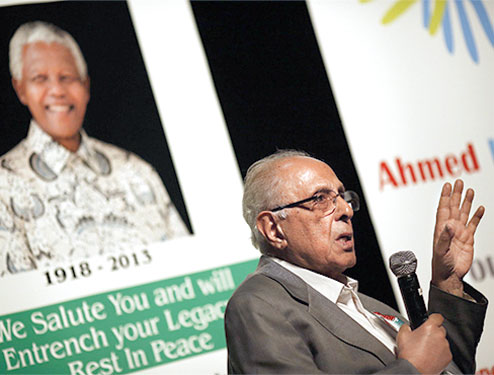
The Indian Nelson Mandela most admired was Yusuf Dadoo, who had died in exile in London. (Mandela once told the Gandhi scholar and anti-apartheid campaigner, E.S. Reddy, that “before Dr Dadoo we were like children”.) His closest Indian friend was probably Ahmed ‘Kathy’ Kathrada (picture), also of communist rather than Gandhian leanings. The two were among the accused in the famous ‘Rivonia’ Trial of 1963, following which they spent more than two decades in prison, mostly on Robben Island. Later, when they were free, ‘Kathy’ recorded a series of interviews with his old comrade, which found their way into a book issued under Mandela’s name with the title Conversations with Myself.

Also a prisoner on Robben Island was Indres Naidoo, whose grandfather, Thambi Naidoo, had played a major part in the satyagrahas led by Gandhi in 1907-9 and 1913-14. Before they were arrested and sent to the Island, Mandela had enjoyed his visits to the Naidoo home, relishing the crab curries cooked by Indres’s mother Mononmony, known more familiarly as ‘Ama Naidoo‘, since she was mother not just to her sons but to many others in the freedom struggle.

In 1997 I made my first trip to the land of Nelson Mandela. I stayed with the Indian high commissioner, Gopalkrishna Gandhi, a scholar, translator, and civil servant whose father was born in South Africa. At a dinner at his home I was introduced to Indres Naidoo. Later, I asked my host about a strange memento on his mantelpiece — a circular metal object with a block of black stone embossed on it, resembling a map of Africa. It was, he answered, a gift from Indres, one of a ‘limited edition’ of aluminium plates made after liberation for the prisoners of Robben Island, these replicating the plates they ate off in their cells, with the map carved out of the same granite they had mined as part of their prison labour. Thambi Naidoo’s grandson was given the keepsake for himself, but, in a gesture characteristic of the man and his family, had chosen to present it to a grandson of Gandhi instead.

Also on that trip, I heard, at a public function, a superb short speech by an elegant, white-haired lady in a sari. Her name was Frene Ginwala. A long-time activist in the anti-apartheid struggle, she had spent many years in exile, partly spent writing a doctoral thesis at Oxford on the history of Indians in South Africa. Herself of Parsi descent, she was now, in 1997, the Speaker of the first multi-racial South African parliament.

Indians constitute less than 3 per cent of the population of South Africa. Yet there were more than 40 Indian members of parliament in that first democratic parliament. When someone complained about this to Mandela, he is said to have answered: “Yes, that is greater than their share in the population, but less than proportionate to their contribution to the struggle.” It was a magnificent rebuttal, that could have come from no other politician of our time — or perhaps any other.

courtesy : 'Politics and play', "The Telegraph", Calcutta, India : December 14, 2013

Loading

...102030...4,1644,1654,1664,167...4,1704,1804,190...

Search by

Opinion

  • डाकियाની દુનિયામાં ડોકિયું : પોસ્ટલ હેરિટેજ પ્રદર્શન
  • દસ મિનિટનો ફોટોગ્રાફ
  • નારી શક્તિને વંદન કે માત્ર શબ્દોની રમત ?
  • ચલ મન મુંબઈ નગરી—359
  • આપણે કયા ગુજરાતની વાત કરી રહ્યા છીએ?

Diaspora

  • આપણે કયા ગુજરાતની વાત કરી રહ્યા છીએ?
  • દશમી ભાષા-સાહિત્ય પરિષદ :
  • યુ.કે.માં ડ્રાઇવિંગની પરીક્ષા
  • અમીના પહાડ (1918 – 1973) 
  • છ વર્ષનો લંડન નિવાસ

Gandhiana

  • આતંકવાદ અને અસમતોલ યુદ્ધના માહોલમાં ગાંધી 
  • શાંતિની સ્થાપના અને જાળવણી શક્ય છે.
  • कौमी संवादिता की मधुशाला[1]
  • શું આ જ કળિયુગની પરિભાષા હશે ? 
  • આંતરિક શક્તિ : હિંમત, અંતરાત્માનો અવાજ અને અહિંસક પ્રતિકાર 

Poetry

  • ને ,પાળ તૂટી! !
  • હળવે હળવે હળવે
  • બગલ ખંજવાળો
  • નિષ્ક્રમણ
  • ગઝલ

Samantar Gujarat

  • ઇન્ટર્નશિપ બાબતે ગુજરાતની યુનિવર્સિટીઓ જરા પણ ગંભીર નથી…
  • હર્ષ સંઘવી, કાયદાનો અમલ કરાવીને સંસ્કારી નેતા બનો : થરાદના નાગરિકો
  • ખાખરેચી સત્યાગ્રહ : 1-8
  • મુસ્લિમો કે આદિવાસીઓના અલગ ચોકા બંધ કરો : સૌને માટે એક જ UCC જરૂરી
  • ભદ્રકાળી માતા કી જય!

English Bazaar Patrika

  • State-Sponsored Communal Profiling : The Gujarat Government Must Be Held Accountable
  • My mother cries on the phone’: TV’s war spectacle leaves Indians in Israel calming frightened families
  • “Why is this happening to me now?” 
  • Letters by Manubhai Pancholi (‘Darshak’)
  • Vimala Thakar : My memories of her grace and glory

Profile

  • તપસ્વી સારસ્વત ધીરુભાઈ ઠાકર
  • સરસ્વતીના શ્વેતપદ્મની એક પાંખડી: રામભાઈ બક્ષી 
  • વંચિતોની વાચા : પત્રકાર ઇન્દુકુમાર જાની
  • અમારાં કાલિન્દીતાઈ
  • સ્વતંત્ર ભારતના સેનાની કોકિલાબહેન વ્યાસ

Archives

“Imitation is the sincerest form of flattery that mediocrity can pay to greatness.” – Oscar Wilde

Opinion Team would be indeed flattered and happy to know that you intend to use our content including images, audio and video assets.

Please feel free to use them, but kindly give credit to the Opinion Site or the original author as mentioned on the site.

  • Disclaimer
  • Contact Us
Copyright © Opinion Magazine. All Rights Reserved