

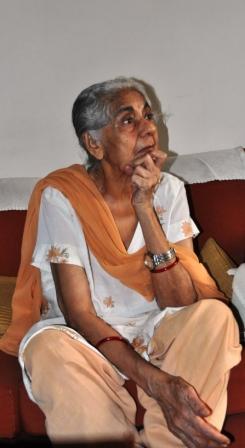
 Over centuries Indians have been sailing the high seas by Dhow in search of commerce, any work for better prospects of livelihood and adventure. They sailed with their Dhows laden with silk, spices, copper and ironware, sugar, rice, guns, and gunpowder etc and sailed to faraway places like Persia, Egypt and Oman. Many of these young men reached Zanzibar, Tanganyika and Malindi Mombasa in Kenya on the coast of great Indian Ocean. From there started trading in different commodities, they tracked on wards to Uganda and all over East Africa. They took up work as civil servants, customs officers, station masters, became traders, started tilling small and big farms and established many industries. In the process they contributed greatly to the economical, political and social development of the country. Initially many of these pioneers came to East Africa from Gujarat and Kutch. Urmilaben Jhaveri's family story is one of those brave stories from Gujarat whose family has spent several generations in Tanganyika where her husband K.L. Jhaveri, was also an elected member of Parliament and together they endeavoured to contribute to both civic and economic life of Tanganyika. Urmilaben has written her autobiography, 'Dancing with Destiny' which is published by Partride Publications. In an interview with Sadananda Sahoo, Veena Sharma, and Rahul Balley, she shared some of her eventful and courageous experiences in Tanganyika and India.
We have been hearing about your riveting experiences in Tanganyika- Tanzania as a social activist, who involved in women empowerment, promoting inter-community relationship. We would like to hear about your life journey in Tanganyika -Tanzania. Those days perhaps it was difficult for women to cross kalapani. How did it happen?
My story began nearly hundred years ago in the late 1920s when my father Tarachand Gandhi arrived in Zanzibar. Those were the days when there was no air travel and it was kalapani even for men. My father was allowed to travel on condition that he should get married first. He married my mother Labhuben who was ten years younger to him. He left her with my grandmother, sailed from Jamnagar to Zanzibar by Dhow, and joined government service as customs officer in Zanzibar. I was born in Pemba in 1931 where he was transferred. After being transferred again to Bagamoyo, Bapuji my father decided to join his brother in Dar-es-Salaam. As my uncle had good experience working as a Compounder in Jamnagar they opened a medical shop and named it Gandhi Medical Shop. They became popular immediately. Dar-es-Salaam is my home town where I grew up, got married to Kanti Jhaveri from Rajkot, raised a family and together we participated in pre and post independence struggle in Tanzania. We witnessed the Zanzibar Revolution, forced marriages, army mutiny, nationalization of assets, Uganda expulsions and so on.
What are the other communities from Gujarat and other parts of Asia; and what kind of occupation they are engaged in to?
Members of Gujarati community came from all over Gujarat including Kutch. There is also a big number of Sikhs and Ismaily Khojas, Bohra and other Muslim families. There are communities from Ceylon, Burma, China and so on. So you see it is a cosmopolitan society. Some members worked for the Colonial government services. Many started with running small dukas and farms and being enterprising and hard working they developed their own whole scale businesses and farms, opened ginneries and small and big scale industries, hotels, medical institutions etc. and went in construction business in a big way.
Can you tell us how the Gujarati Community engaged into business , especially linking with other businessmen at home.
Some businessmen who had the facility to trade as whole sellers imported their goods from India and as I remember it from Japan and UK as well. They supplied the small Dukawala. In those days all businesses transactions were run on mutual trust. Goods were delivered and payments to be made were agreed though the word of mouth and a piece of paper called chithi.
How do you think about their ethnic and inter community relationship?
Tanganyika was a Trust Territory under the British Colonial rule and similar to South Africa and Kenya. The Colonial government ruled Tanganyika with an iron fist strictly on racial basis. Thus the people were categorized according to their race; Europeans were at the top of the ladder, then Asians in the middle, and the Africans were placed at the bottom. All this was changed only after a young leader Julius Nyerere emerged and led the independence struggle in Tanganyika. And I am happy to say that my husband and I were very much part of this struggle and were involved in it from the beginning. The country gained Independence in 1961.
Most of the time, interrelations between the communities especially between Muslims and Hindus were healthy but deteriorated after the partition of India and Pakistan during and after the partition of India and Pakistan it was disturbed. And yet people of all communities including Hindus-Muslims, Sikhs and Christans as neighbours and friends always shared celebrations and festivals and were on friendly terms.
I remember in Bagamoyo my best friends were Sakker and Kulsa; Ismaily sisters who helped their mother run their small shop selling khangas and other dress material. I spent as much time as possible with them and enjoyed watching their customers, mostly African women bargaining with them in good humour.
Tell us something about how the Asian Communities practice of Religion?
There are Temples, Gurudwaras, several Mosques for all denominations and Churches as there are all religious groups amongst the Asians. For example Hindus go to the temples, Muslims to the Mosques, Goans attend service in Churches and Sikhs visit Gurudwaras. In Dar-es-Salaam a Bhadara -feast was held every Sunday and on auspicious days where all were welcome. Thus the religious life is simple and peaceful.
You have worked with the women empowerment movement in Tanzania. What is your experience as an activist?
All those years when I was an active member of the Central Committee of the National Women's Organization – UWT were very fulfilling years for me. Those were the days when the country and the people as a whole were struggling for development on all fronts but the women were the most marginalized and deprived members of the society. They were bound by age old social taboos and customs, wife beatings and other oppression, and leading their life practically without any amenities was a way of life for them. And even water and light, clinics or elementary education was not available to them.
Our organization was responsible for formulating the policy and initiate projects to help the women. As such our first priority was to visit the women, try to end her age old hardship by initiating self help projects to give her some financial leeway and bring them on the main stream of the society so that they can share in the general progress.
Mama Sophia Kawawa the Prime Minister's wife was our Chairperson. Very simple by nature she never expected any special privilege for herself and was just one of us. And the members of the CC of UWT comprised of many women leaders who were brilliant achievers in their own professions. During our field work in villages we shared living space, food, ideas and arguments.
We visited all parts of the country. This gave me the rare opportunities to visit the remotest part of the country and meet the women, discuss the problems facing them and help to try to find the solution for these problems. By living with them we got the first hand knowledge about their predicament. It was a bumpy process but if we wanted the women to take their rightful place in society we had to begin at the beginning. Over the years we did manage to achieve quite a good number of our goals.
It was most satisfying experience and for me this bond with the women remains as strong as ever, whether I was sharing with my friends a meal, a song, a life times story, an argument or holding hands with a half necked mad man or listening to a witches call !
We heard that you are an excellent cook specializing in so many varieties of delicious Gujarati food which we relished at your home. How did you manage to preserve all these food culture in Tanganyika?
My mother was a very good cook. I learnt to cook all these varieties from her and enjoy cooking different food. My husband was elected Member of Parliament from Dar-es-Salaam Constituency and our house was always full of guests and I enjoyed feeding them. In Tanzania all the traditional spices, vegetables and other items are available. Just to mention a few names, you will find dhokla, bhajia, khandvi, pani pury ,bhel puri, jalebi gathita, patra , sev khaman, idli dosa and so on every where in the country.
You have a family which is truly transnational. How do you maintain the relationships? Which is your real home?
Yes, young members of our family are spread across different countries; Britain, Australia, USA, Afghanistan, Switzerland, India, Scotland and so on. They visit us from time to time. However there is no official family gathering as such. But then internet and mobile phone are always there at hand. And my home is where I am staying!
You have been in India since last four years. This is after 80 years of living in Tanganyika – Tanzania. How is your return experience; and how do you feel here in Noida?
There are always two sides to a coin; gain and loss and plus as well as minus points. For us moving from Tanzania where we had spent the best years of our life in fact my entire life [eighty years], was a very difficult decision to make. My parents had died and all the other family members including our children had moved away gradually. My brother-in-law and his family from Uganda were now settled in UK. My late husband and I were not keeping in good health, so our best option was to move to India where we could receive medical treatment easily and meet our children frequently.
Of course, it was a difficult transition and we both missed Dar-es-Salaam where Jhaveriji was Babu I was Bibi- grandmother for everybody. It is interesting to note that, all these years in Tanzania our life was based on Indian culture, religion, food habits and so on and we had been visiting our daughters and her family in Delhi from time to time. But even then when we moved I felt like a stranger here in Delhi. What is more even the vegetable vendor could make out that I am a, 'baharwale'. I started writing my autobiography, 'Dancing with Destiny' to keep myself mentally occupied. Fortunately I finished writing it and it is now published.
Now that feeling of not belonging and not being able to cope with the new environment is also gone. My neighbours are very friendly and I have met many nice people like you.
I thank you all for taking interest in my story.
Thank you so much for sharing this invaluable experience of your life journey with us.
Interview Date: Thursday, May 29, 2014
Person Name: Urmila Jhaveri
courtesy : http://grfdt.com/InterviewDetails.aspx?TabId=1033 or http://grfdt.com/Interviews.aspx
—
Dr. Sadananda Sahoo : Asst. Professor, School of Interdisciplinary and Trans-Disciplinary Studies, Indira Gandhi National Open University Maidan Garhi, New Delhi 110 068

 રાજવટ : દેશ અને સમાજની વિકટ સમસ્યાઓ રાજવી માટે આફત નથી, પણ લોકપ્રતિષ્ઠા મેળવવાનો રાજમાર્ગ છે