
Opinion Magazine
Number of visits: 9772466
  •  Home
  • Opinion
    • Opinion
    • Literature
    • Short Stories
    • Photo Stories
    • Cartoon
    • Interview
    • User Feedback
  • English Bazaar Patrika
    • Features
    • OPED
    • Sketches
  • Diaspora
    • Culture
    • Language
    • Literature
    • History
    • Features
    • Reviews
  • Gandhiana
  • Poetry
  • Profile
  • Samantar
    • Samantar Gujarat
    • History
  • Ami Ek Jajabar
    • Mukaam London
  • Sankaliyu
    • Digital Opinion
    • Digital Nireekshak
    • Digital Milap
    • Digital Vishwamanav
    • એક દીવાદાંડી
    • काव्यानंद
  • About us
    • Launch
    • Opinion Online Team
    • Contact Us

The day he left us

Inder Malhotra|English Bazaar Patrika - Features|15 November 2014

Nehru died at the precise moment we set foot in Muzaffarabad, the capital of PoK.

On the day Jawaharlal Nehru passed into history, I was in Pakistan as a consequence of his last major policy decision. Overruling his senior advisors, he released his old, if estranged friend, Kashmir’s towering leader, Sheikh Mohammed Abdullah, from prolonged and unjust imprisonment; withdrew the meandering “Kashmir Conspiracy” case against him; invited him to be his house guest at Teen Murti; and encouraged him to go to Pakistan to explore with its then president Field Marshal Ayub Khan the possibility of a settlement of the Kashmir issue. “Let Sheikh try,” he told his cabinet. Preceded by a large number of us journalists, the Sheikh arrived in Rawalpindi on May 23 and was given a reception reserved for a friendly head of state or a national hero. For three days, he and the field marshal held extensive talks, but on the evening of May 26, he and a Pakistani spokesman announced the failure of the Sheikh’s mission. However, both sides also stated that in the month of June, Nehru and Ayub would meet in Delhi and the Sheikh “would not be far away from the conference table”.

Despite understandable disappointment over the talks’ failure, there was great excitement on the morning of May 27 because Sher-e-Kashmir (as Abdullah was usually hailed) was going to “Azad Kashmir”, and the Pakistan government had reluctantly allowed Indian journalists to accompany him. Our instructions were stern: “Be at the president’s guesthouse by 7.45 am because the Sheikh’s caravan will leave exactly at eight”. We knew better but decided to obey. In the best subcontinental tradition, nothing happened for a couple of hours.
We were saved from boredom, however, by cordial conversations with our hosts and endless rounds of tea, coffee and delectable kebabs.

At one stage, a Pakistani colleague and friend, Asrar Ahmed, asked me whether Ayub and Nehru would be able to work out a compromise on Kashmir. This, he added, was vital because these two were perhaps the last leaders who could “sell” a compromise to their respective peoples. Stressing the obvious, I replied: “Asrar, it depends on how much time Nehru has.” At this, everyone at my table exclaimed: “May Allah prolong his life!” As if on cue, Hafeez Jullundhri, the nearest thing to a poet laureate Pakistan had and a virtual minister-in-waiting during the Sheikh’s stay, walked up to our table and occupied one of the several chairs vacated for him. Then he told me in chaste Punjabi: “Inder Malhotra, both of us on either side of the Wagah border are b*******. You people have had a long ride feeling superior to us because you were lucky to have Nehru to lead you for so long. Our misfortune was that Jinnah died within 13 months after the birth of Pakistan and Liaquat was killed soon afterwards. Now Nehru is not going to last, and then you will descend to our level.” While some tried to remonstrate with the much-respected Hafeez, Sheikh sahib came out and the incident was brushed aside in the excitement of departure.

I don’t know whether Murree’s Lintott’s Restaurant still exists but it was in the midst of a most friendly reception at it that we first heard that Nehru had been taken ill. The exuberant mood was replaced by anxiety. Nehru died at the precise moment we set foot in Muzaffarabad, the capital of Pakistan-occupied Kashmir. I cursed my fate that I had to be away from Delhi. My second worry was that Muzaffarabad was not the best place to be in because people there were likely to be hostile to Nehru. But as I looked around
I was stunned. The large crowd that had collected to welcome Sheikh Abdullah had turned into a mourning mass. With both hands raised skywards, everyone was praying for Nehru. The epicurean meal the Kashmiris call wazwan remained completely untouched. There was a commotion in a distant part of the gathering. Someone was beating his forehead with both his hands and cursing his “black and evil tongue”. He was also shouting my name. It was Hafeez Jullundhri. He came up to me and apologised profusely.

The Sheikh joined us to calm down Hafeez. Instead, the two tall men embraced and sobbed.

Agha Shaukat, a Pakistani official, whose two brothers held very senior posts in Srinagar, drove Prem Bhatia, my professional guru and then Delhi editor of The Indian Express, and me to foreign minister Zulfikar Ali Bhutto’s house in Rawalpindi. However, on the way, he stopped at a dhaba near a small town and insisted that we have tea and snacks. I don’t know how our presence became known to them but a large number of people came to express condolences to us. Each said: “He was a great and good man.” At Bhutto’s residence, some Delhi-based foreign correspondents were already present and arrangements had been made to fly us to Delhi as soon as possible. The overworked crew of the aircraft could not have been more courteous and helpful to us.

It was late in the night when we landed at Palam. I decided to go home via Teen Murti. But reaching near it, I discovered that the area was so crowded by those assembled to have the departed leader’s last darshan that my driver had to turn back and take a different route. Since Nehru’s funeral had to be delayed for the arrival foreign dignitaries, more and more crowds kept pouring into the Indian capital from different parts of the country. In death, as in life, Nehru’s popularity had to be seen to be believed. After he had been consigned to the flames, the eminent British journalist, James Cameron, reported in The Guardian that on that day Delhi had become the “most overpopulated spot on the hemisphere”.

The writer is a Delhi-based political commentator


http://indianexpress.com/article/opinion/columns/the-day-he-left-us/99/#sthash.vmJVROXc.dpuf

courtesy : “The Indian Express”, November 14, 2014

Loading

Nehru held the ship of state firm over rough waters of Partition

Karan Singh|English Bazaar Patrika - Features|15 November 2014

The memory of great men often fades with times: The Gandhi generation has gone and the Nehru generation is passing rapidly. It is, therefore, important to preserve the legacy of these remarkable leaders so that future generations remain aware of their contribution to achieving and consolidating our dearly won freedom.
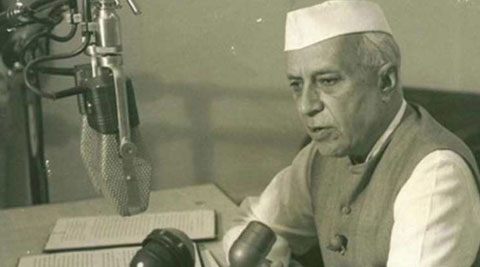
We now take our Independence for granted, but it is often forgotten that at least a million people were brutally murdered in the process and as many as ten million uprooted from their homes on both sides in what was probably the largest mass migration in human history. To stabilise and consolidate the situation after Independence required statesmanship of a high order, and the Cabinet, led by Jawaharlal Nehru and including stalwarts like Sardar Vallabhbhai Patel as deputy prime minister and Maulana Abul Kalam Azad, was able to do this. The first great achievement of Nehru after Independence, therefore, was to hold the ship of state firm amid the turbulent waters of the Partition process, despite predictions of the prophets of doom, including Winston Churchill, who said that after the British left India would Balkanise and break up into a dozen units.

The second great task was, after centuries of foreign rule, for India to get itself a new Constitution. Himself an impeccable parliamentarian, Nehru not only took a keen interest in the framing of the Constitution but also attended Parliament for long hours, answered questions and in particular spoke on foreign relations, a portfolio he had kept with himself.

After Partition, India was a patchwork quilt consisting of what used to be called ‘British India’ and hundreds of princely states ranging from large ones like Jammu and Kashmir, Hyderabad, Mysore, Baroda and Gwalior to tiny principalities. Knitting these separate units into a single State was a massive task, the main credit for which goes to Sardar Vallabhbhai Patel. The non-violent integration of so many feudal states into a democracy was surely unprecedented in world history. Although Nehru left this area mainly to Patel, he closely monitored the whole process and, despite his strong anti-feudal feelings, he realised the importance of seeking the cooperation of the ruling princes.

Nehru was deeply committed to the development of science and what he called the scientific temper, an attitude devoid of superstition and blind faith. For this purpose he had the foresight to set up the Indian Institutes of Technology in major cities around the country.

The underpinning of the whole saga of independent India has been an unwavering commitment to democracy. Nehru, steeped in the liberal democratic traditions of Britain, the republican ideals of the French Revolution and the socialist vision of the Russian Revolution, was a firm votary of democracy. It is interesting to recall an anonymous letter that appeared in the late 1930s in the Modern Review saying:

“(Nehru) has all the makings of a dictator in him — vast popularity, a strong will directed to a well-defined purpose, energy, pride, organizational capacity, ability, hardness, and with all his love of the crowd, an intolerance of others and a certain contempt of the weak and the inefficient…From the far north to Cape Comorian he has gone like some triumphant Caesar, leaving a trail of glory and legend behind him…(I)s it his will to power that is driving him from crowd? His conceit is already formidable. He must be checked, We want no Caesars.” Astoundingly, he had written that article pseudonymously!

A major triumph consisted in his leadership of what came to be known as the Non-Aligned Movement, along with President Nasser of Egypt, President Tito of Yugoslavia and Archbishop Makarios of Cyprus. President Sukarno of Indonesia was also involved, although his actions were often erratic.

His greatest tragedy, of course, was China. Nehru believed that the new China, which emerged after the overthrow of the previous regime, and which had suffered long periods of colonial domination, would be a natural ally of India in the post-colonial period.

Despite the long undemarcated border with China, Nehru was convinced that differences could be sorted out in a spirit of goodwill and mutual adjustment. As it turned out he underestimated the Chinese drive for power. The whole Chinese disaster has been widely researched and written up, except that the Henderson Brooks’ report on the debacle has still not been made public.

The whole episode caused Nehru immense shock and embarrassment. He was obliged to sack his favourite Krishna Menon. The failure of the whole Panchsheel approach to China was something that shattered Nehru’s psyche. He never really recovered from this setback and passed away within less than two years thereafter. Despite the Chinese debacle, the Indian Foreign Service today owes its origin to him, because after the British had left he had to build the whole service virtually from scratch.

Another area in which he faced difficulties, of course, was the issue of Jammu and Kashmir. Suffice it to say, after my father (Maharaja Hari Singh) had signed the Instrument of Accession in the wake of the Pakistani invasion, the much-criticised reference to the United Nations once again flowed from his idealism and his firm belief, strongly encouraged by Lord Mountbatten, that the newly created international body would clearly identify the aggressor and take steps to have the invasion withdrawn.

Nehru was a bitter opponent of religious fundamentalism, whether Muslim or Hindu. There is a view that Nehru’s attitude towards religion tended to be dismissive, and that despite all that he has written in the Discovery of India, he was never at ease with organised religion. This was largely true, though in his writings he did pay rich homage to the Upanishads and Shankaracharya, and he was particularly impressed by the Buddha and his teachings.

The people of India held Nehru in special affection which is reflected in his last will and testament, where he says: “If any people choose to think of me, then I should like them to say this was a man who, with all his mind and heart, loved India and the Indian people. And they, in turn, were indulgent to him and gave him of their love most abundantly and extravagantly.”

I will close with another quotation that could appropriately be directed towards Nehru. It is from Shakespeare’s Julius Caesar and refers to Brutus. But it could very well apply to Nehru. “His life was gentle, and the elements so mixed in him that nature might stand up and say to all the world this was a man.”

Karan Singh is  a Rajya Sabha MP

The views expressed by the author are personal

http://www.hindustantimes.com/comment/analysis/nehru-held-the-ship-of-state-firm-amid-the-turbulent-waters-of-partition/article1-1285852.aspx#sthash.WqXFF1Iy.dpuf

courtesy : “The Hindustan Times”, November 13, 2014

Loading

Nehru: The writer, the historian

Mushirul Hasan|English Bazaar Patrika - Features|13 November 2014

Whosoever is in power, Jawaharlal Nehru’s memory must be kept alive in the interest of our democratic and secular values. Students of Indian history will benefit from his writings, which embrace the creative thrust and splendour of the Continental and Indian civilisation

Certain segments in our society are engaged in a futile and odious comparison between the tall leaders of our freedom struggle; some others are out to diminish Jawaharlal Nehru’s stature and repudiate his legacy. Without being swayed by the rhetoric of the publicists or the ill-informed mediamen, we need to bolster Nehru’s position as the second best leader after the Mahatma. “Swachh Bharat” will not do. Whosoever is in power, Nehru’s memory must be kept alive in the interest of our democratic and secular values. Students of Indian history, on the other hand, will benefit from his writings, which embrace the creative thrust and splendour of the Continental and Indian civilisation.

Nehru was a voracious reader : he read 55 books from May 21, 1922 till January 29, 1923 alone. He delved into philosophy, and turned the pages of history to illuminate his understanding of the ideas and movements, which stood apart as the catalyst for momentous changes. In so doing, he looked through other people’s writings to understand how simple, ordinary men and women became heroes, and how their strivings made history stirring and epoch-making. Prison had made a man of him, he told the Socialist leader, Acharya Narendra Deva (1889-1956), while they were in jail for the last time in 1942.

Writing to regenerate


Why did he write? Who did he write for? He had no archives to consult; so he relied on his recollections and on bits of information that he could conceal. He disliked being called a writer, and yet, armed with a varied experience of affairs, writing became a congenial occupation. Sometimes he didn’t write for weeks, now and again he wrote daily. His letters from jail represented his moods and thoughts at the time of each event; they were also his escapes from gaol.

He wrote to regenerate his generation, to render them capable of following Gandhiji’s non-violent satyagraha, and to put before them the tangled web of current affairs in Russia, Germany, England, America, Japan, China, France, Spain, Italy and Central Europe. It was a tangled web no doubt, difficult to unravel and difficult even to see as a whole. Yet, he presented the many-coloured life of other ages and countries, analysed the ebb and flow of the old civilisations, and took up ideas in their full flow. The superimposed loneliness empowered him to turn to himself for fellowship and guidance, arrange his thoughts, and evolve his political creed undisturbed by external influences. This exercise affected the whole gamut of his emotions.

In enchantment of history


Jawaharlal Nehru’s writings transmit the enthusiasm and animation he felt for the discipline of history. In fact, there is something uncanny about the way in which a self-taught and amateur historian like him explored the unbounded universe in full variety. True, his vision was far from settled, but it was being etched out in conjunction and in contention with other voices.

He lived in the enchantment of the ancient and medieval histories of India, and sought to understand it in terms of the present and even of the future to come. Why should there be so much misery in the world? This question troubled him. Why do people argue and quarrel among themselves as a sect or a religious group? Why are they blind to the vision of freedom? His comments on political affairs, many of which tend to corroborate or supplement, to a fair degree, with the information that is available to us from some other sources.

Nehru asked what he was heir to, and answered that he was heir to all that humanity had achieved over tens of thousands of years, to all that it had thought and felt and suffered and taken joy in, to its cries of triumph and its bitter agonies of defeat, to that astonishing adventure, which had begun so long ago and yet continued and beckoned to man. Besides commenting on the wisdom of India’s great inexhaustible spiritual heritage, he talked of the vital necessity to apply it intelligently and reasonably to the present and the future.

His vision was hardly ever trapped in the exclusivist, culturological mode; far from it; it was supremely inclusive and driven by a belief in the existence, even the necessity of cultures constantly interacting with each other, of cultures working on and transforming the other and their own through a live contact. In fact, he talked of a whole people becoming full of faith for a great cause, and brought to the fore their treasures of knowledge, learning, heroism and devotion. He looked at the entire world with a fresh eye and gave a balanced view of man’s life on many continents. His was a global view — not an Asian view any more than it was a European one.

Understanding ideas


With this eclectic approach, he called for breaking down national histories and constructing a more relevant world history as a means to understand the global exchange of ideas in the past and the necessity of exchange for a better future. He wanted books not for specialists alone but also for the general, interested lay reader in a popular and accessible mode. He wanted books on the daily lives of ordinary men and women who lived in the past (family budgets from hundreds of years ago, he suggests could show us how life was organised in that age!). And he wanted Asia’s history to be read as widely as possible so that the readers should think of all the countries and all the peoples, and not merely of one little country.

Glimpses of World History is not a standard textbook, but it still makes an impression of sustained intellectual power. Received with a chorus of admiration, it has become standard reading in India, Africa, Europe, and the United States. Fenner Brockway (1888-1988), a friend of India and for many years Secretary of the Independent Labour Party, mentioned that his daughter learnt more from Glimpses than any other history book she had studied at school.

Written almost entirely in prison in the 1930s, it bears the mark of a passionate, albeit humane, nationalism. Others have also put pen to paper on their life and times, but the biography glows with patriotic feelings. There is no cover-up, and no concealment of facts. As for the “self,” the influences are too subtle, too diffused, to be easily identified or measured. The author loved India tenderly, and, in the words of Monod, to him that loved, much may be forgiven.

Autobiographical confessions cannot be regarded as accurate descriptions of a consistent life, and yet Jawaharlal Nehru’s narrative is out of the ordinary precisely for its tropes and figures of thought, without which he would not have turned the real events of life into a narrative and transform them from a chronicle into a story.

The Discovery of India is a hymn to the glories of India. He mapped the metaphysical and philosophic approach to life, idealised ancient India as a world apart, independent of and superior to the rest of the civilisations, toning down the barbarism of the caste system and throwing the warm colours of fancy around his narrative. At the same time, with his eyes set on India’s infinite charm, variety and oneness he worked ceaselessly for a synthesis, drawing on the best, and breaking with the worst. He consciously followed Gandhi and Tagore in the direction of the universal. Consequently, India appears in The Discovery as a space of ceaseless cultural mixing, and in the past as a celebration of the soiling effects of cultural miscegenation and accretion.

The Nehruvian legacy


While the romantic in Nehru drew on the old and new interpretations to buttress an ecumenical and universalistic point of view, some of the other Indian writers did so from a rather narrow perspective. He conducts the reader through the labyrinth of a colonial era, narrates the most complex events, and recreates portraits of outstanding fellow countrymen. By and large, his writings make public the spirit and substance of his many-sidedness, the deep-seated urge to freedom, and the negative response to the concomitants and consequences of colonial rule.

What is the Nehruvian legacy? Those living in a vibrant parliamentary democracy and amid creative institutions should not ask this question unless they wish to be identified with the Nehru-debunkers. They must remember that Nehru kept the country together, established secular ideals, propelled it forward with the thrust of science and modernity, healed some of the wounds of Partition, and stood before the world at the head of the non-aligned camp. “Men may break,” Gandhi was to say on the eve of the Quit India Movement, “but they should not bend beyond brute force.” His political heir did just that through his public life. He shared with tens and thousands of prisoners the changing moods of exaltations and depressions, of intense activity and enforced leisure. He buttressed the idea that man is not just a simple individual but a crowd of thoughts and ideas.

What raised Nehru in public estimation was his concern for the poor and the underprivileged. The life of the people, which flows in a dark current beneath political events, attracted his attention — the circumstances, sorrows and joys of millions of humble men and women. Even if his personal misfortunes had a melodramatic tinge, there was, always, a constant element of moral austerity to serve as a counterweight.

(Mushirul Hasan is Jawaharlal Nehru Fellow and, formerly, Vice-Chancellor, Jamia Millia Islamia, and Director General, National Archives of India.)

courtesy : “The Hindu”, 13 November 2014

Loading

...102030...3,9283,9293,9303,931...3,9403,9503,960...

Search by

Opinion

  • તમાકુ ને પ્લાસ્ટિક : સઘળું ઇલાસ્ટિક !
  • યુદ્ધોન્માદી માહોલ, વસમા પાડોશી અને સંરક્ષણ બજેટ
  • શું ભારતની પ્રજા આવું કરી કે સહી શકશે?
  • સોશિઅલ મીડિયા એન્ટિ-સોશિઅલ છે…?
  • અમેરિકાના હાલ બેહાલ, હાથનાં કર્યા હૈયે વાગ્યાઃ વૈશ્વિક મહાસત્તાનો આત્મવિશ્વાસ જ આત્મઘાતક બન્યો

Diaspora

  • યુ.કે.માં ડ્રાઇવિંગની પરીક્ષા
  • અમીના પહાડ (1918 – 1973) 
  • છ વર્ષનો લંડન નિવાસ
  • દીપક બારડોલીકરની પુણ્યતિથિએ એમની આત્મકથા(ઉત્તરાર્ધ)ની ચંદ્રકાન્ત બક્ષીએ લખેલી પ્રસ્તાવના.
  • ગાંધીને જાણવા, સમજવાની વાટ

Gandhiana

  • આંતરિક શક્તિ : હિંમત, અંતરાત્માનો અવાજ અને અહિંસક પ્રતિકાર 
  • માનવતાવાદી ત્રિપુટીને સ્મરણાંજલિ 
  • ગાંધી ‘મોહન’માંથી ‘મહાત્મા’ બન્યા, અને આપણે?
  • ગાંધીહત્યાના પડઘા: ગોડસેથી ગોળવલકર સુધી …
  • ગાંધીની હત્યા કોણે કરી, નાથુરામ ગોડસેએ કે ……? 

Poetry

  • ગઝલ
  • વિધ્વંસ
  • કવિ
  • ગઝલ
  • ગઝલ

Samantar Gujarat

  • ઇન્ટર્નશિપ બાબતે ગુજરાતની યુનિવર્સિટીઓ જરા પણ ગંભીર નથી…
  • હર્ષ સંઘવી, કાયદાનો અમલ કરાવીને સંસ્કારી નેતા બનો : થરાદના નાગરિકો
  • ખાખરેચી સત્યાગ્રહ : 1-8
  • મુસ્લિમો કે આદિવાસીઓના અલગ ચોકા બંધ કરો : સૌને માટે એક જ UCC જરૂરી
  • ભદ્રકાળી માતા કી જય!

English Bazaar Patrika

  • My mother cries on the phone’: TV’s war spectacle leaves Indians in Israel calming frightened families
  • “Why is this happening to me now?” 
  • Letters by Manubhai Pancholi (‘Darshak’)
  • Vimala Thakar : My memories of her grace and glory
  • Economic Condition of Religious Minorities: Quota or Affirmative Action

Profile

  • તપસ્વી સારસ્વત ધીરુભાઈ ઠાકર
  • સરસ્વતીના શ્વેતપદ્મની એક પાંખડી: રામભાઈ બક્ષી 
  • વંચિતોની વાચા : પત્રકાર ઇન્દુકુમાર જાની
  • અમારાં કાલિન્દીતાઈ
  • સ્વતંત્ર ભારતના સેનાની કોકિલાબહેન વ્યાસ

Archives

“Imitation is the sincerest form of flattery that mediocrity can pay to greatness.” – Oscar Wilde

Opinion Team would be indeed flattered and happy to know that you intend to use our content including images, audio and video assets.

Please feel free to use them, but kindly give credit to the Opinion Site or the original author as mentioned on the site.

  • Disclaimer
  • Contact Us
Copyright © Opinion Magazine. All Rights Reserved