

23 April 2018
Many epithets have been used to run down the Commonwealth. The London summit may even be called the Commonwealth Games II…
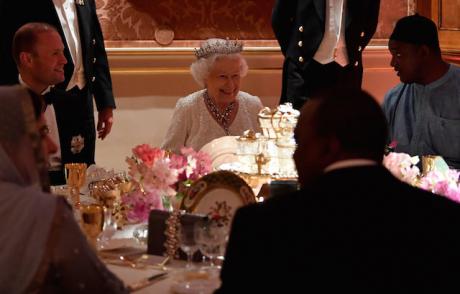
Queen Elizabeth II hosts a dinner at Buckingham Palace in London during the Commonwealth Heads of Government Meeting. April 19, 2018. Toby Melville/Press Association. All rights reserved.
It was a grand family reunion. The head of the family opened her magnificent home for the members coming from all over the world. She won them over by a charming smile and the display of her wealth. Her wish became her command.
The Queen and her Government, suspicious of revolutionary fervour, easily convinced the diverse family members that continuity and stability were more desirable. With great foresight, the Queen intervened politically to suggest her successor, since the office of the Head of the Commonwealth is not hereditary. The member-nations readily accepted the suggestion. So, it was formally announced that when the time comes, Prince Charles will be the Head of the Commonwealth. The decision was an excellent gift to the Queen on the eve of her 92nd birthday.
The Queen, as the Head of the Commonwealth, and her Government that hosted the London summit, felt victorious. The endorsement by 52 other countries should discourage the minority of Britons who keep talking against the monarchy.
The endorsement by 52 other countries should discourage the minority of Britons who keep talking against the monarchy.
This summit was to have “transformed” the Commonwealth, a voluntary inter-governmental organisation of Britain’s former colonies. There was much talk of its being reimagined, renewed and revitalised. It was to have been modernised. That was what its supporters and critics had hoped. The intense involvement of the royals has thus come in for some criticism.
The decision to have the Prince of Wales as the next Head of the Commonwealth was variously attributed to “strong consensus” and “unanimity”. The pro-democracy activists would like to know the process through which this consensus was secured. The dark secret may be revealed when a retired head of the state writes his memoires.
A British correspondent asked at the press conference whether it was democratic that an unelected leader selected another unelected person to succeed her in the Commonwealth office. A Head of the State did not respond to this question.
There were hostile comments from ordinary people including a member of the Indian Diaspora. Some said Prince Charles was not fit for the job. Some criticised royal nepotism. Some felt offended. Some saw a trace of racism and gender inequality because the Prince is a white male. One saw it as a hideous and laughable reminder of the Empire.
But that was not what the leaders had felt. They were not sensitive about the royal relationship. The “royal show”, as it was planned, did not remind them of the Durbar. The leaders quite liked being in Buckingham Palace and in Windsor Castle. It was a great photo opportunity, and some clicked away their mobile phone cameras. The constituents back home will be impressed that their leader shook hands with the Queen!
Of course, how could they defy the head of the family. Family values are deeply ingrained in societies in which the young ones respect the head. And the Queen is quite a sweet old lady. Only a British author would move her from her palace to a bed-sit.
So, the Queen ruled the Commonwealth Summit!
And the Queen is quite a sweet old lady.
Money well spent
It was a big diplomatic victory for the British Government that had discreetly lobbied for such future transition. The Prince of Wales readily recalled his association with the institution from his childhood. The Government that ran a huge bill on hosting the Summit saw it as money well spent.
The Commonwealth is no longer called the British Commonwealth but then what is in a name? Call it just “Commonwealth” but even decades later, as the London summit proved, it still smells like the British Commonwealth!
A vociferous section of commentators in Britain minds it. The tiny group of the Republicans minds it. But the member states themselves don’t mind it. Not even the leader of the largest member-nation who rails against dynasties. The British shahzada was acceptable to all!
Those ideologically opposed to the monarchy and dynasties do not see the other side of the coin. Most feudal societies do not care for their advocacy of elections for every office. And at times, elections cause a lot of trouble and instability!
The pragmatists recognise that during her long reign, the Queen has provided the glue that has kept this unique family of diverse nations together. She sided with the wishes of the majority in the family when a dominant member such as her own Government went against it, as happened during South Africa’s struggle against apartheid.
There have been many suggestions from British Labour leaders and others about having an elected Head of the Commonwealth. Considering the political confrontation going on in some of the democracies and semi-dictatorial regimes in the Commonwealth, a decision for having an elected Head could open a can of worms. Headship by rotation! Some wonder: when will the nation whose name begins with ‘Z’ assume office?
And what happens when an elected head of Government is thrown out of office in a mid-term election? So, howsoever outdated the concept of hereditary office in the context of the Commonwealth, no one has placed a better alternative on the table.
Civil society talk shows and other missed opportunities
Leaving the Queen’s role aside, some other steps could have been taken to modernise the Commonwealth and making it appear less tied to the royals and the British Government. In fact, in order to clinch the issue of succession, the Royals were made to play an even more dominant role this time. Most of its members of the royal family and their assets were deployed for impressing the guests from the former colonies. This had the desired effect. The Prime Ministers and Presidents walking on the endless stretch of the red carpet were overwhelmed by the images and statues.
The infrastructure for running the Commonwealth is largely British. The malady has been known for years. An old study had highlighted that the largest share of consultancy and aid programme contracts given out by the Commonwealth Secretariat were going to the British firms. There were case studies indicating how some projects in Africa had to be closed down because of the inappropriate technologies recommended or sold by British firms.
The sorting out of the succession issue may have ensured a measure of stability and continuity in future, but it distracted from whatever the London summit said to promote sustainable development, security and a clean environment.
The leaders’ meetings and the retreat were preceded by the civil society talk shows. The exchange of ideas among the activists belonging to the women, youth and human rights groups would have enriched the political perspective of any leader who could have spared any time to attend these meetings.
Moving tales were heard of discrimination and oppression and of suppression of the freedom of expression. A young successful woman politician lamented that she lost her first boy-friend and was having trouble with the second one because in her country it is believed that a woman cannot succeed in politics unless she has slept with a powerful leader!
While these fora were officially part of the summit, there was not much evidence in the official communique of any inputs received from these. The Commonwealth Human Rights Initiative or the Commonwealth Journalists Association, dealing with some of the burning issues today, have no reason to feel satisfied with the outcome of the summit.
The host Government, under domestic pressure to promote gay rights, felt afraid of displeasing the guests. So, The British Prime Minister had to remain satisfied by making a fleeting reference to this issue in her statement at the concluding press conference. She slipped in a comment about the use of nerve agent in the UK and the use of chemical weapons in Syria.
The summit highlighted the growing vulnerabilities caused by climate change and the rising sea levels. The issue concerns the Commonwealth even more since many of its member-nations are exposed to such natural calamities and being small states have no resources to deal with the tragedy. The summit sensitised the participating leaders to the pollution of the oceans by plastic. The issue was in the news because the host Government decided to do something about it like banning plastic straws.
The summit sensitised the participating leaders to the pollution of the oceans by plastic.
The leaders adopted a Commonwealth Blue Charter designed to cover one-third of the world’s national coastal waters and help sustain livelihoods and ecosystems globally. “They agreed on a bold, coordinated push to protect the ocean from the effects of climate change, pollution and over-fishing.”
Their communique inevitably covered cyber security, health and education and “Commonwealth values”.
Commonwealth values
The leaders expressed their concern over rising protectionism and reaffirmed their commitment to a transparent, rule-based multilateral system of free-trade. The issue of trade and investment was deliberated at length at the Business Forum. The leaders committed themselves to the vision of increasing intra-Commonwealth trade to 2 trillion US dollars by 2030 and expanding intra-Commonwealth investment.
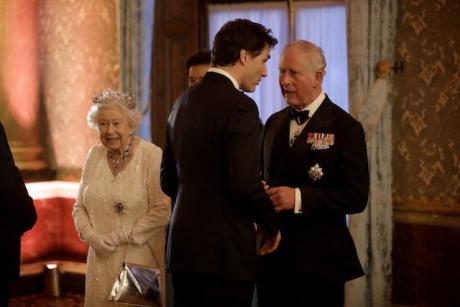
Prince of Wales and Queen Elizabeth II greet Canadian Prime Minister Justin Trudeau in the Blue Drawing Room at Buckingham Palace. Matt Dunham/Press Association. All rights reserved.
Britain’s economic diplomacy in this context is under attack from two sides. The Europhiles say the Commonwealth will never make up the loss that Britain will suffer because of leaving the European Union. The Commonwealth supporters say Britain should stop looking at the member-nations just as trading partners! They want Britain to treat them as long-lost cousins who were betrayed when Britain joined the European Union.
This summit will be remembered most by the relief it brought to the Caribbean migrant families settled for decades in Britain who were facing the threat of deportation and some of whom had been deported as they could not prove their British citizenship. Known as the “Windrush generation” as their forefathers came by this ship to help a war-devastated Britain to rebuild itself.
The issue was taken up by the media and the opposition in a big way. Tragic stories of individual families were published and shown on the TV day after day. Migration is a sensitive subject in domestic politics: but despite that the newspapers and TV channels showed no bias in favour of the Government or waved the flag of nationalism. They all wanted to be “fair”.
The Prime Minister met the Caribbean leaders, offered apologies, promised immediate action and even agreed to the Labour Opposition’s demand for compensation to the families.
Since the issue had the potential to disrupt the Commonwealth event, the host Government went into fire-fighting mode to minimise the damage. The Prime Minister met the Caribbean leaders, offered apologies, promised immediate action and even agreed to the Labour Opposition’s demand for compensation to the families victimised by what was officially described as a “hostile immigration policy”. This lowered the anxiety of the concerned Commonwealth leaders and the summit was immunised against any ill-effect.
It was an unprecedented Commonwealth summit. It was the biggest such meeting. It got more than usual media coverage. Thanks to the distribution of Commonwealth information packs in schools, ignorance about this institution may reduce.
The summit was held amid extraordinary fanfare as well as trenchant criticism by the opinion-makers angered by the Brexit politicians flourishing the Commonwealth as a counter-veiling economic force to Europe! A book, launched to coincide with the summit queered the pitch. Ironically, it is written by the director of the Institute of Commonwealth Studies, Philip Murphy. The book is called The Empire’s New Clothes: The Myth of the Commonwealth.
A book, launched to coincide with the summit queered the pitch.
The summit turned him into a media star and he let out a flood of comments about the Commonwealth facing “an existential crisis”. Many epithets have been used to run down the Commonwealth. The London summit may even be called the Commonwealth Games II.
The London summit did push the organisation towards tradition, frustrating the endeavour to make it modern. The dream of reimagining the Commonwealth will remain a dream for some time.
About the author
L K Sharma has followed no profession other than journalism for more than four decades, covering criminals and prime ministers. Was the European Correspondent of The Times of India based in London for a decade. Reported for five years from Washington as the Foreign Editor of the Deccan Herald. Edited three volumes on innovations in India. He has completed a work of creative nonfiction on V. S. Naipaul.
https://www.opendemocracy.net/openindia/l-k-sharma/queen-rules-commonwealth
