

The Band of Brothers
Unlike many other communities in India, Gujaratis are almost in every part of the world. They are known to be traders, trade unionists, business tycoons and entrepreneurs. They rank in the list of the wealthiest individuals in the world for a state with less than five per cent of India’s population. However, the Gujarati identity is made of many other elements and layers. Their contribution to other spheres—such as art, culture, science and literature is immense.
 And so is in the domain of politics. Gujaratis have financed the freedom struggles of two countries, India and South Africa. But so have they financed—and aggressively cheered—the rise of Narendra Modi.
In a globalised world, the diaspora has become a pivotal site from where political ideals of the homeland are defined, reconfigured, and eventually realised. Overseas Gujaratis, commonly known as Non-resident Gujaratis (NRGs), play a vital role in (re)building political and popular consciousness. Having a personal connection to their home state, NRGs often donate to construct schools, libraries, and other development projects in their villages. In return, such philanthropy activity earns them respect and special recognition. Their words are taken more seriously when the stakes are high, like the upcoming Assembly Elections. They feel a strong affinity with Modi and deeply resonate with the pragmatic political culture Gujarat is widely known for.
NRGs are likely to target villagers across Gujarat, as there is significant resentment against BJP in rural areas. The leading business man from Los Angeles has made a strategy for the diaspora community to reach out to the local communities. It has set a target of persuading at least one lakh voters across the state. Dr Vasudev Patel, National Organisation Secretary of BJP in the USA, said they follow two campaign strategies. While some NRI’s work on the ground and campaign in different villages, others who could not make it to India take to online campaigns, make phone calls to their relatives, villagers, neighbours and tell them why they should vote for BJP. “They also make online videos on it and share on social media platforms,” said Patel.
In Anand, where the BJP lost to Congress by a considerable margin in 2017, over two thousand NRIs are expected to actively campaign on the ground for BJP.
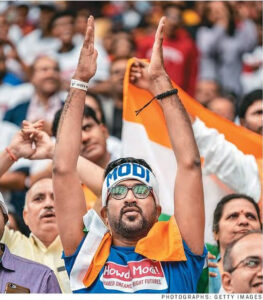
As various parameters suggest, Patidar (Patel) votes will determine the election’s result. Members of the large Patel community, a sub-caste of Hindu traders located in the western side of Gujarat, have grown to dominate the American motel market during the last thirty years. The Asian American Hotel Owners Association (AAHOA)—the largest body of hotel owners in the US whose members are responsible for 1.7 per cent of the US’s GDP—has some 70 percent Gujaratis members, of which three-quarters are Patel. A large number of NRGs are likely to campaign in Morbi, where the recent tragedy has spotlighted a Patidar-dominated constituency.
The Convenor of Overseas Friends of BJP (OFBJP), Los Angeles, confirmed that more than one lakh green card holder Gujaratis have arrived in Gujarat. Some diasporic communities from New Zealand, Australia and UK have already landed in the state, while others are likely from Fiji, Canada, the US and other countries.
The Gujarati diaspora also funds the BJP. Way back in 1970, the Gujarat government established a bureaucratic department to promote investments from NRGs. They may not elect local politicians, but they actively participate in adversarial public events. A leading Gujarati diaspora group, Vishwa Gujarati Samaj (VGS), based in Ahmedabad, has been felicitating prominent, influential Gujarati personalities for the past seventeen years. Last year, the ceremony was attended by Gujarat Governor Acharya Sevvrat and BJP Rajya Sabha MP Parshottam Rupala. The organisation is currently reaching out to the ‘rural population’ to make ‘democracy stronger.’
Several coalitions of Gujarati diaspora organisations have recently advertised for diasporic Gujaratis’ unequivocal support for BJP’s leadership in the assembly elections. The advertisements dominate various social media channels. With the help of Facebook and various communication channels, communities unable to travel to Gujarat from the UK, Canada, and Australia are urging locals to defeat the ‘Tukde Tukde Gang,’ pointing at Congress and AAP.
The Swaminarayan sect, followed initially by the Patels, has also played an extensive role in silently formulating and shaping Gujarat politics. The Ram Janmabhoomi Temple, built in Ayodhya, showcases the unique characteristics of the Swaminarayan temple architecture. To retain the elements of Hindu culture for the diaspora, the Swaminarayan sect has built grand temples worldwide. Unlike traditional temples, they actively engage with communities, mobilising funds and volunteers for social work.
The internationally famous sect has enabled Gujarati communities to proudly anchor their Hindu faith, locally and internationally. Whether it is the inauguration of important events and landmarks by a leader hailing from the sect or the incorporation of communities from lower castes over the years, they have enormously influenced Gujarati communities worldwide.
With its seed in Gujarat, Hindutva politics is more than just a vehicle for the state’s upwardly mobile Hindu caste groups to secure political dominance. Through their constant endorsements, these caste groups, particularly Patels, are increasingly able to directly or indirectly benefit from Hindutva politics internationally with their direct opportunism base in the homeland.
Though cosmopolitan, the community has been tolerating violence—whether the riots in the 1980s or 2002, as the majority of the Gujarati diaspora has always supported the Hindutva project. Whether by sharing WhatsApp forwards or by mobilising in large groups to show solidarity with the Modi-led-BJP government, NRGs have 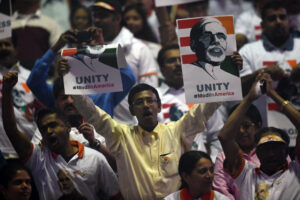 significantly normalised the religious divide on various domestic and international platforms.
Regional mainstream media organisations have also played an active role in significantly giving NRGs voices prominence. In mid-October, a leading Gujarati news channel brought more than twenty-five hundred Global Gujaratis on a single platform. It also felicitated various influential personalities in business and culture through its three-day gathering in the city. Adani Group, owned by an Indian-Gujarati billionaire who trots the globe with Narendra Modi, was one of the event’s sponsors. Appearing right before the elections, the event aptly captured the entrenched bond among the BJP, the Gujarati diaspora and the media.
Some of the Gujarati diasporic groups identify themselves as Hindu Gujaratis rather than Gujaratis which has been an inclusive and accepting ethnic community historically. Such manufactured identities are then picked by communities in the homeland and are enabled by the contours of sectarian politics.
Whether it is the continuous projection of Gujarat’s neoliberal economic growth model or the institutional support from organisations like OFBJP or Hindu Swayamsevak Sangh (HSS), the diaspora’s influence over India’s economic boom and the BJP politics has consistently grown over the decades.
Gujarati’s long-distance nationalism highlights the fundamental contradictions in diaspora communities and raises crucial questions about Gujarat’s inclusive culture. Though diasporic aspirations of becoming internationally acclaimed result from India’s democratic success, their political goals for the homeland endanger Gujarat’s real Asmita.
Kalrav Joshi is a London-based journalist and writer.
[“Outlook”, December 12, 2022; pages : 44-45
The piece for The Outlook published: https://www.outlookindia.com/national/wealthy-and-influential-non-resident-indians-pull-out-all-stops-for-a-bjp-win-magazine-241376

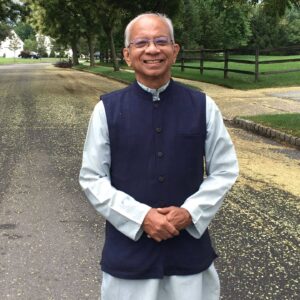 It was ‘Constitution Day’ once again on 26 November, as the nation remembered with profound gratitude the day in 1949, on which the Constituent Assembly ‘adopted, enacted and gave to ourselves’ a meaningful Constitution. The day was also a reminder that ‘Constitution Day’ for the citizens of India cannot be relegated to just one day- it has to be observed every single day; and secondly, the Constitution belongs to ‘we, the people of India’ and we should never allow it to be desecrated by anyone at any time!
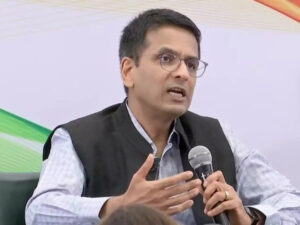 He went on to add that, “It is essential that the judiciary reaches out to the people and not to expect the people to reach out to the judiciary. The infrastructure of technology must not be dismantled. Though the Supreme Court is located at Tilak Marg, it is the Supreme Court for the entire nation. The virtual access has made it possible for lawyers to argue cases from their own places. As a CJI, I am looking to adopt technology in listing of cases and court hearings, which will help to weed out institutional flaws such as delay in listing and hearing.” In doing so, he gave a clearly direction to the judiciary and of course reiterated the fact that the Constitution belongs to ‘we the people of India!’
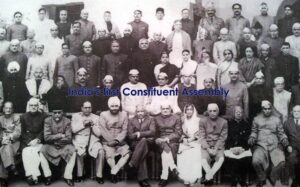
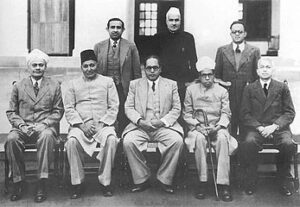 On the eve of the enactment of the Constitution, 25 November 1949, in a passionate speech to the Constituent Assembly, Dr B.R. Ambedkar, the father of our Constitution, gave three unambiguous warnings: the need to give up the grammar of anarchy, to avoid hero-worship, and to work towards a social – not just a political – democracy! Ambedkar was, at that time, perhaps visioning what India could become in 2022, and how these three aspects could not only destroy all that was sacred in the Constitution, but could result in the dismantling of the democratic framework which a new resurgent India was just born into and committed to!
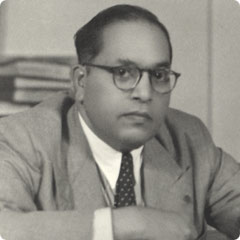 Ambedkar added, “Will history repeat itself? It is this thought, which fills me with anxiety. This anxiety is deepened by the realisation of the fact that in addition to our old enemies in the form of castes and creeds, we are going to have many political parties with diverse and opposing political creeds. Will Indians place the country above their creed or above their country? I do not know, but this much is certain that if the parties place creed above country, our independence will be put in jeopardy a second time and probably be lost forever. This eventuality we all must resolutely guard against. We must be determined to defend our independence with the last drop of our blood!”
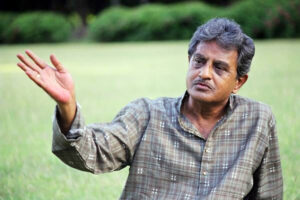 Ramesh Parekh is one of the pinnacle names of Gujarati poetry.
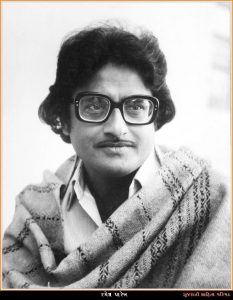 After one or two songs, Vinubhai Mehta introduced both poets. We gave all of them flowers to welcome and आवकार – अभिवादन.
 His poems’ images, metaphors, and similes’ are of the most profound and of cosmic level at the same time of the most earthly daily KATHIAWADI routine realities. He had KATHIAWADI colloquial (તળપદી) vocabulary in his poems which he mentioned that he adapted from his mother.