
Most of the countries of South Asia have faced the barbaric problem of violence targeted against religious minorities. The form of this may have been different, but the outcome has been similar, the brutality against religious minorities, violence against innocent human beings. The current times (Mid 2013) may be one of the worst when in the spate of short span of we are witness to violence in Pakistan, Bangla Desh, India and Myanmar, more or less running parallel. Many a times when talk about violence involving Muslims has been under discussion, some propagandists have tried to associate Islam with violence and so the strife. Similarly some others may say that Hinduism permits violence as in Gita or so and so is the problem. In popular perception Buddhism is the religion of peace. The truth is that while the religious precepts are for morality, the part of religion invoked for violence has more to do with contemporary political issues, which are given the garb of religion. While Lord Gautama Buddha is surely the major apostle of peace, one has seen violence by Buddhist monks in Sri Lanka, Thailand and now overtly in Myanmar (March 2013).
Troops are keeping a vigil, martial law has been declared to stop the communal rage which has lasted for three days in Meikhatila in Myanmar. This violence has involved the Buddhists and Muslims. Here the official toll stands at 31 dead, while the unofficial figures are higher. A state of emergency has been declared in this state. As usual a trivial incident involving the argument between the Buddhist couple and a Muslim owner of gold shop resulted in the triggering of simmering dislikes and discord between these two communities resulting in violence. While one Buddhist monk has also been killed the major victims of the violence are Muslims. This bring to our memory the communal clash of June -July (2012) in Rakhine State in western Myanmar. In that violence officially 110 people were killed and it left 120,000 people homeless. Those killed and left homeless were mostly stateless Rohingya Muslims.
Interestingly the communal strife was under the wraps during the preceding dictatorial regime. With the efforts to bring in democracy in some form these strife’s are coming to surface due to the diverse and plural nature of Myanmar society, which is majority Buddhist but has substantial number of Muslim minorities. Rohingiya Muslims are probably the most persecuted minority in the world. Being a substantial number in Myanmar, they are from Indo-Aryan group, who settled in this part over a period of last couple of centuries, during the British rule, primarily. While the majority Buddhists are of Sino-Tibetan stock. Muslims live in the Western state of Rakhine state on country’s Western border. They have been adversely affected by the 1982 citizenship law, which has deprived them of the citizenship; there is a total violation of their human rights due to this unjust law. They are subjected to forced labour and have to work for the Government without any pay. The UNHCR has noted that since 1991 their freedom of movement is restricted. They are treated like second class citizens. Facing this adverse situation of gross violation of their rights many of them are trying to flee to Thailand, Malaysia and other places amongst others.
In 2012, June-July the violence between Rakhine Buddhists and Rohingya Muslims was triggered by the rumour of rape of a Buddhist girl. As such it was a case of Muslim boy and Buddhist girl falling in love and eloping to get married. The boy was murdered and two of his friends who helped him to elope are facing death sentence.
Overall this reflects the unsolved problem of secularization and democracy in the region. The common factor in whole of South Asia is the migration of people for economic reasons, and with independence coming many of the dominating communities wanted to associate citizenship rights based on religion. Due to this some communities got deprived of citizenship formally or informally. Some were relegated to second class citizenship in practice. In Sri Lanka, the large number of Tamils who had gone there as plantation labour was denied equal rights and denied equality leading the extreme reaction in the form of formation of Liberation Tiger of Tamil Elam (LTTE).
In Myanmar 5% of the people are Muslims. Many of them had been the residents of this region from centuries. Denying them full citizenship defies all the logic of a modern democratic state. During the regime of military junta, which ruled the country for decades, a wrong precedent has been set, that of linking citizenship with religion. It requires deeper investigation as to why many a monks have an anti Islamic attitude. One knows similarly many a monks had played anti-Tamil role in Sri Lanka. There must be deeper societal processes which are at work and are usurping the democratic norms of equality of religions. One knows that democracy is coming up in Myanmar after long decades after long battles, but still the remnants of the communal divide are dogging this nascent democracy. In a way this is also the colonial legacy which subtly promoted the divisiveness in the society.
With this violence in Myanmar coming to the fore the whole South Asia has to wake up and come to the grips of the legacy of the colonial past, a legacy perpetuated due to economic and political policies of rulers, rulers who have in a short-sighted manner resorted to abuse of religious identity for their political goals. Some political tendencies have thrived on the identity of religions and spread the ‘Hate’ about ‘other’ community. It is retarding the process of development in each of South Asian countries and also putting strong brakes on the same. South Asia should have been striving towards the process of formation of South Asian Federation, which can expedite the processes leading to peace in the sub continent. Regional peace in turn is a prerequisite for development of the regions. We need to look beyond the narrow religious identities and promote the freedom of religion, equality of religions and dignity and honour for people of all the faiths for a better environment in those countries and a more congenial atmosphere for enhancement of human rights of weaker sections of society.
Issues in Secular Politics, I April 2013
www.pluralindia.com

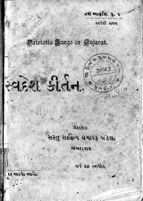 Another interesting fact should also be noted. Gandhi influenced Gujarati language and literature to such an extent that the period between 1920 and 1950 is usually referred to as the Gandhian Period of Gujarati literature. So, one would expect Gujarati books and periodicals to lead the tally of banned books in India. But the number of forfeited Gujarati books is considerably less compared to some other languages. As per figures provided by the National Archives of India, largest number of such items (402) belongs to Hindi. Urdu comes second with 126 items, and Punjabi third with 114 items. These are followed by English (89 items), Marathi (88 items), Gujarati (61 items), and Bengali (48 items).
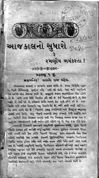 Narayan Vasanji Thakkur (1884-1938) was a prolific writer. He published more than 100 books. One of his social novels Aajkaalno Sudharo ke Ramaneey Bhayankarta published in 1911 was also proscribed. Even with a close reading, one cannot find anything against the Government in this 352 page novel. Then why would the Government ban it? This was perhaps because the book is out and out against social reforms. And in the process of denigrating the movement for social reforms, it also criticizes, even ridicules, everything British – their social, educational, and legal systems, their penchant for alcohol and non-vegetarian food, etc. Ever since the social reform movement began in Gujarat in the second quarter of the 19th century, a small but vociferous group opposed everything modern, everything western. Thakkur belonged to this group.
 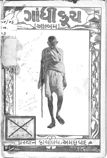 It was intriguing for me to find an album of Gandhiji’s photographs in the list of proscribed books. But when I saw the book, the reason for doing so was apparent. All photographs in the book relate to the 1930 Dandi March and the accompanying text, written by Rasiklal Parikh (1897-1982) is highly critical of the Government’s handling of the March. He has also quoted extensively from Gandhiji’s articles and speeches.
 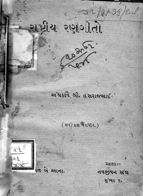 Even after considerable efforts, I have not been able to find any biographical details for ‘Blind Poet Hansrajbhai.’ But he was one of the most popular songsters during the period of our freedom movement. Rashtreey Rangeeto is an 18 page booklet, but almost every page has dynamite laid on it for the British Government. One of the songs opens thus:
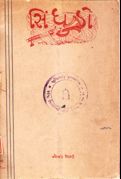 Traditionally, we refer to Gujarati literature produced between 1920 and 1950 as literature of the Gandhian Period (Gandhi Yug). But surprisingly, not many books written by leading lights of this period appear in the list of banned books. Two exceptions are Zaverchand Meghani and Manubhai Pancholi, alias ‘Darshak.’ Zaverchand Meghani earned the title of ‘the National Poet’ from a person no less than Gandhiji. Most of the poets and poems related to our freedom movement are almost forgotten today, but Meghani and his poems are an exception. His Sindhoodo, a 30 page booklet containing only 16 songs, is perhaps the most celebrated of books proscribed by the British Government. It was first published on April 6, 1930, the first day of the Civil Disobedience Movement. By the time the British Government proscribed it, most of its ten thousand copies were already sold. Unnerved by its popularity, the British Government charged Meghani with making a seditious speech and the Court at Dhandhuka (a town in Saurashtra region of Gujarat) sentenced him to imprisonment for two years. After the magistrate delivered his judgment, with his permission, Meghani recited one of the poems contained in Sindhoodo.
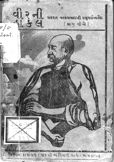 Sardar Vallabhbhai Patel’s speeches made during the 1930 movement were collected in two volumes under the title Veerni Hakal. The first edition of ten thousand copies of the first volume was sold out within no time. Second volume was published within a few months. However, the British Government proscribed both volumes. Preface to the first volume was written by Mahadev Desai, personal secretary to Gandhi, while awaiting arrest in a police station.
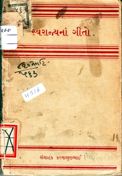 Kalyanji Mehta, a veteran freedom fighter from Surat collected some songs popular during the freedom struggle under the title Swarajyana Geeto. The first volume containing some 155 songs by various poets was published in 1931 to mark Gandhiji’s birth day, and was soon proscribed. The second edition, containing 157 songs, was published in 1938 to mark the 51st Session of the Congress held at Haripura. By this time, the then Bombay State had a Congress Government, and its Home Minister Dr. Kanaiyalal Munshi had revoked the ban imposed earlier.
 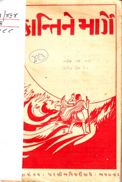 Krantine Marge, (On the Road to Revolution) was written in 1930 but was published in 1932. Author Prabhakar Biharilal wanted Kaka Kalelkar to write its preface and so gave him the manuscript. Kalelkar put it in his travel bag so that he can read it while traveling. But the bag was stolen during one of his train journeys. Kalelkar issued press advertisements requesting the thief to return at least the manuscript. But he did not. Luckily, the author had another copy of the book and Kalelkar ultimately wrote preface to the book, hence the delay in its publication. But the book was proscribed soon after its publication.