

"Why are students not taught that before the Wright brothers, an Indian called Shivkar Bapuji Talpade was the first to invent the airplane? This person invented the plane eight years before the Wright brothers. Are our students taught these things in IITs or not? They should be," These are the gems from our MHRD minister, Satyapal Singh while speaking at an award ceremony. Such utterances have matching policies which are influencing the direction of our research-teaching in the field of science and technology. Not too long ago, minister of Science and Technology Harsh Vardhan formed a high level committee to undertake research and to promote the benefits of Panchgavya. This Panchgavya is a mixture of cow’s urine, dung, milk, curd and ghee (purified butter). IIT Delhi will be the nodal institution for ‘research’ in to this.
There are reports that MP government has plans to set up astro OPD (Out Patient Department), consultation centers, where the astrologers will be giving the predictions about their illness to the patients. This is planned to be done under the aegis of the state sponsored institution in Bhopal. The Uttarakhand Government, in collaboration with AYUSH of Ministry of Health, has started the hunt for magical Sanjivani booti. This mythological herb was the one for which Lord Hanuman had to fly with the whole mountain as Lord Ram’s younger brother, Laxman, had become unconscious. The prestigious IIT Kharagpur is not only planning to introduce Vastu Shastra in their undergraduate teaching program but also have a center for Vaastu Shastra, which is advising people to install the statues of Lord Ganesh and Lord Hanuman in front of their houses to ward off the evils.
These policies are the outcome of the understanding which the RSS inspired BJP leaders have. Just a couple of years ago, our Prime Minister Narendra Modi while inaugurating a Modern Hospital in Mumbai drew the attention of his audience to the great strides which India had made in the ancient times. “We can feel proud of what our country achieved in medical science at one point of time. We all read about Karna in Mahabharata. If we think a little more, we realize that Mahabharata says Karna was not born from his mother’s womb. This means that genetic science was present at that time. That is why Karna could be born outside his mother’s womb… We worship Lord Ganesha. There must have been some plastic surgeon at that time, who got an elephant’s head grafted on the body of a human being and began the practice of plastic surgery.”
These magical-fictional things have been making their ways into the school books being introduced by BJP governments in different states. One Mr. Dinanath Batra’s book Tejonmay Bharat is an example. The book teaches the students ““America wants to take the credit for invention of stem cell research, but the truth is that India’s Dr Balkrishna Ganpat Matapurkar has already got a patent for regenerating body parts…You would be surprised to know that this research is not new and that Dr Matapurkar was inspired by the Mahabharata. Kunti had a bright son like the Sun itself. When Gandhari, who had not been able to conceive for two years, learnt of this, she underwent an abortion. From her womb a huge mass of flesh came out. (Rishi) Dwaipayan Vyas was called. He observed this hard mass of flesh and then he preserved it in a cold tank with specific medicines. He then divided the mass of flesh into 100 parts and kept them separately in 100 tanks full of ghee for two years. After two years, 100 Kauravas were born of it. On reading this, he (Matapurkar) realized that stem cell was not his invention. This was found in India thousands of years ago. (Page 92-93)
The mythology is becoming the basis of science. While mythology has beauty of a fiction; to regard it as true defies the scientific spirit, the spirit of scientific temper. On similar lines the assertion is that we had Television as Sanjay narrated the battle of Mahabharata to Vyas, or that since Lord Ram used Pushak viman, so the aeronautical technology was in vogue. These defy all common sense. One has to know that to develop that level of such technology one needs advanced infrastructure in various disciples of science. Such a development comes in to being only from eighteenth century onwards.
No doubt ancient India has massive contribution to science in the form of contributions of Sushrut, Charat and Aryabhat. But to regard that we had all science and technology in toe is an ideological manipulation to construct ‘our’ greatness’. Ideologues of freedom movement came to emphasis on scientific temper, which should be foundation of India and this got enshrined in our Constitution. Muslim Nationalism and Hindu nationalism saw history as that of great kings belonging to particular religion, and their scriptures having all the knowledge. Today Hindu nationalists occupying the seats of power are out to destroy the gains of scientific achievements during last seven decades and bring in faith based fantasies in the area of scientific enquiry, knowledge and technology. This is a retrograde move.
It is precisely in protest against this that we saw scientists rational thinkers took to streets on 9th August to emphasize that pseudo science should not be permitted in the areas of research and scientific learning. These multicity protests also called for enhancement of budget for science and education. The distinction between science and pseudo-sconce is clear and obvious; science encourages being questioned and criticized, while pseudo science resorts to hearsay, faith and suppresses dissent. In a country where huge gains have been made due to scientific temper, it is pertinent that we uphold polices laid down in our constitution which calls for promotion of scientific temper. We need to bypass the utterances of the likes of Satya Pal Singh and his cabal as far as formulation of national policies of scientific research and education are concerned.
http://www.thecitizen.in/index.php/NewsDetail/index/4/11898/Can-Science-Survive-Blind-Faith

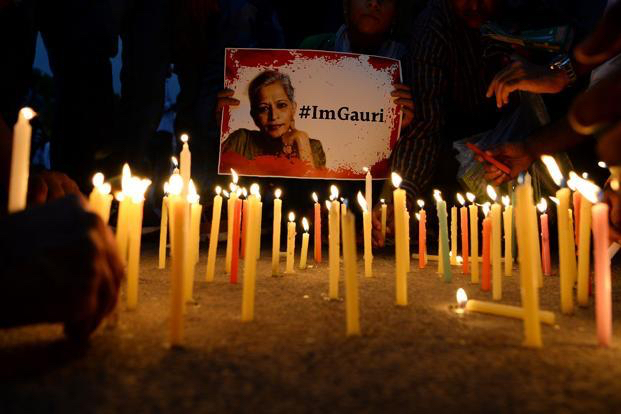 Murder of Gauri Lankesh (5th September 2017) came as a big shock to those who uphold progressive liberal values. The same was celebrated by Hindutva supporting trolls, many of who are being followed by none other than Prime Minister Modi. Gauri was not just a journalist but also a leading activist of Bangalore. She was editor of the Kannada magazine, Gauri Lankesh Patrike, taking off from Lankesh Patrike, which was founded by her father. She was strong critique of caste, Brahmanism and Hindu nationalist politics of RSS. She had been sticking her neck out on the issues related to defense of democratic and social rights. She stood for defense of rights of minorities in an unequivocal manner and supported the cause of Lingayat being a separate religion, thereby rejecting the hegemony of Brahmanism, as Brahmanism is the dominant tendency within Hinduism,
 The period starting September 2016 has been my loneliest phase till date. The loneliness at first was deliberately desired but it slowly became a cause of great anxiety and later grew into a depression. For far too long, I have wished to write about mental health based on my experiences of what I went through and what I still suffer (albeit in a very truncated sense). A long impending emotional outburst resolved my several month-long internal conflict about whether to write or not write reflecting on the dreadful part of loneliness i.e. depression: Whether the personal should come out in public or not?; how do I balance the sentimental with the rational? I decided to hurriedly write this slightly long piece yesterday not thinking of many such questions that ringed inside my head (breaking boundaries of some grammar rules): In the process, this has become more of an unorganised personal tale; better to publish it with its imperfections than not. Hence, unconcerned of what many would think, today, I wish to open up.